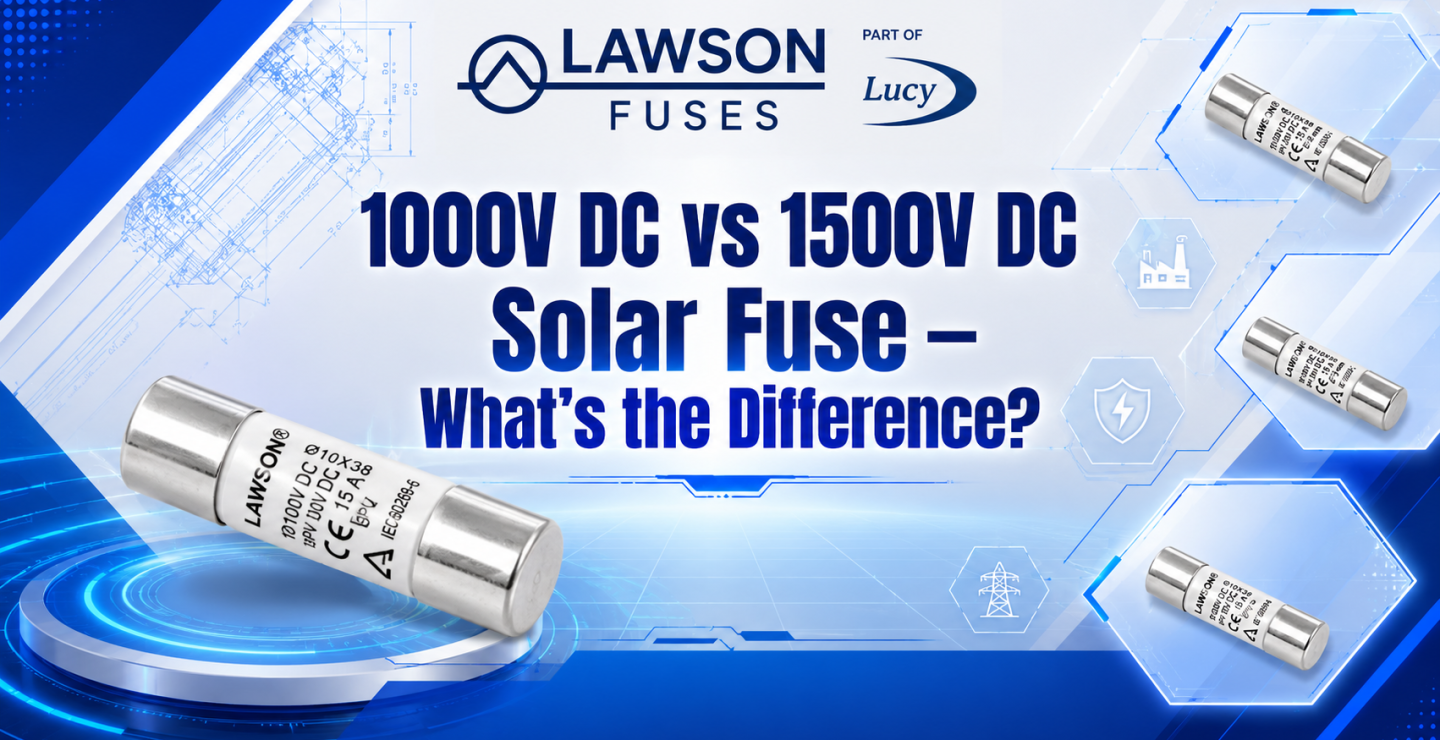
Key point: A 1000V DC solar fuse and a 1500V DC solar fuse are not interchangeable. Using the wrong voltage-rated fuse in a solar PV system is a serious safety hazard — and one of the most common specification errors in modern solar installation.
Why Voltage Rating Is the First Decision in Solar Fuse Selection
When specifying a solar DC fuse for a photovoltaic installation, most engineers and installers instinctively reach for the current rating first. How many amps does the string produce? What cable size is being used? What is the panel’s Isc?
These are important questions — but they come second. The very first decision in solar fuse selection is voltage rating: is this a 1000V DC system or a 1500V DC system?
Get this wrong, and no amount of correct current rating selection will produce a safe or compliant installation. A solar fuse fitted at the wrong voltage rating may appear identical on the outside, fit the same fuse holder, and carry the same current rating — but it will fail to safely interrupt a DC arc at the actual system voltage if a fault occurs.
This guide explains exactly what distinguishes a 1000V DC solar fuse from a 1500V DC fuse, why the difference matters physically, when each applies, and how to confirm the correct specification for any solar PV project.
The Two Solar PV Voltage Standards
Modern solar PV systems are designed around one of two principal DC system voltage architectures. Both are in widespread use today, but they serve different market segments and impose different requirements on every component in the DC circuit — including the PV fuse.
1000V DC — The Established Standard
The 1000V DC system voltage limit is the long-established maximum for conventional photovoltaic string systems. Defined under IEC 61730 (PV module safety qualification) and referenced in IEC 62548 (PV array design requirements), 1000V DC has been the design limit for residential, commercial, and many utility-scale PV systems for well over a decade.
In a 1000V DC system, the maximum open-circuit voltage (Voc) of any series-connected string of panels must not exceed 1000V DC under any operating condition — including the low-temperature, high-irradiance conditions that produce the highest Voc values. The number of panels per string is calculated to keep the string Voc within this limit.
The solar DC fuse for a 1000V DC system must be rated for 1000V DC operation — tested and certified to interrupt DC arcs at this voltage without risk of sustained arcing or explosive failure.
1500V DC — The High-Voltage Generation
The 1500V DC system voltage standard is the newer, higher-voltage architecture that has become the dominant choice for utility-scale solar farms and large commercial PV installations over the last five to eight years.
The shift from 1000V DC to 1500V DC is driven by simple economics and physics: at a higher system voltage, the same power is delivered at lower current. Lower current means smaller cable cross-sections, fewer combiner boxes, reduced resistive losses, and lower balance-of-system (BOS) costs per kilowatt of installed capacity. For a 50MW solar farm, the BOS cost savings from a 1500V DC architecture compared to 1000V DC can be significant.
However, those cost savings come with a non-negotiable requirement: every DC-side component in the system — including inverters, combiners, disconnect switches, connectors, and PV fuses — must be rated for 1500V DC operation.
A 1500V DC solar fuse is a distinct, separately certified product — not simply a 1000V fuse with a different label.
What Makes a 1500V DC Solar Fuse Different?
The difference between a 1000V DC and 1500V DC solar fuse is not merely a specification on a datasheet. It reflects fundamental differences in the physical engineering of the fuse-link. Understanding why helps clarify why substitution between the two is never acceptable.
Arc Interruption — The Core Challenge
When any fuse operates under DC conditions, the critical engineering challenge is arc extinction. Unlike AC circuits, where the current passes through zero 100 times per second and the arc extinguishes naturally at one of these zero crossings, a DC circuit maintains continuous current flow with no natural zero. The arc that forms when the fuse element melts must be forcibly extinguished by the fuse design itself.
The higher the DC system voltage, the greater the arc energy that must be contained and extinguished during fuse operation. A fuse operating at 1500V DC must handle substantially more arc energy than the same fuse would encounter at 1000V DC. If it is not designed for this, the arc may not extinguish — sustaining indefinitely or causing catastrophic fuse failure.
The two principal design differences that enable a fuse to handle higher DC arc energy are:
Greater physical length — The Lawson LFPV-32 (1000V DC solar fuse) uses the standard 10x38mm cylindrical format. The Lawson LFPV-35 (1500V DC solar fuse) uses a 10x85mm format — more than twice as long as the 1000V equivalent. The additional length provides greater arc path length within the fuse body, making arc extinction at 1500V DC achievable. This is why 1500V DC fuses cannot physically fit in 1000V DC fuse holders — the holder is too short to accommodate the longer body.
Enhanced arc-quenching design — The composition, density, and distribution of the quartz sand fill within the ceramic body is engineered specifically for the arc energy profile at the rated voltage. A 1000V DC fuse body filled for 1000V arc energy will be overwhelmed by the higher arc energy of a 1500V DC fault.
Certification and Testing
A 1500V DC solar fuse must be independently tested and certified to IEC 60269-1 and IEC 60269-6 at 1500V DC — not extrapolated or assumed from 1000V DC test data. The breaking capacity tests, arc interruption tests, and operational tests defined in IEC 60269-6 are all conducted at the rated voltage. A fuse certified at 1000V DC has not been tested at 1500V DC and cannot be assumed to perform safely at that voltage.
Side-by-Side Comparison
| Parameter | 1000V DC Solar Fuse (LFPV-32) | 1500V DC Solar Fuse (LFPV-35) |
| Rated DC Voltage | 1000V DC | 1500V DC |
| Physical Format | 10 × 38mm cylindrical | 10 × 85mm cylindrical |
| Current Ratings Available | 1A, 2A, 3A, 4A, 5A, 6A, 8A, 10A, 12A, 15A, 20A, 25A, 32A | Contact Lawson sales team |
| Breaking Capacity | 20kA DC | Refer to datasheet |
| Utilisation Category | gPV | gPV |
| Standard | IEC 60269-1 & IEC 60269-6 | IEC 60269-1 & IEC 60269-6 |
| Typical Application | Residential, commercial rooftop, small ground-mount PV | Utility-scale solar farms, large commercial ground-mount |
| Compatible Fuse Holder | 10×38mm PV fuse holder | 10×85mm PV fuse holder |
| Interchangeable? | No — never substitute between voltage ratings | No |
Which One Does Your Solar Project Need?
Use a 1000V DC Solar Fuse When:
The project is a residential rooftop system. Virtually all domestic solar PV installations in the UK and Europe are designed to a 1000V DC system voltage limit. String lengths are calculated to keep Voc within 1000V DC under minimum temperature conditions, and the inverters, combiners, and all DC-side components are specified for 1000V DC. The LFPV-32 (10x38mm, 1000V DC, 1A–32A) is the correct solar fuse for string-level protection in these systems.
The project is a commercial rooftop system. The majority of commercial rooftop solar installations — office buildings, retail units, warehouses, schools, hospitals — are also designed to 1000V DC. The higher 1500V DC architecture requires 1500V DC-rated inverters and all associated equipment, which increases component cost and may not be cost-effective for smaller commercial rooftop systems. Confirm the inverter’s maximum DC input voltage before selecting the fuse voltage rating.
The inverter is rated for 1000V DC maximum input. The inverter datasheet will specify its maximum DC input voltage — typically 1000V, 1100V, or 1500V DC depending on the product. If the inverter’s maximum DC input is 1000V or 1100V, the system is a 1000V DC architecture and requires 1000V DC solar fuses.
The system uses standard 60-cell or 72-cell crystalline silicon panels at typical string lengths. Conventional 60-cell panels have a Voc of approximately 37V–45V and 72-cell panels approximately 44V–52V at STC. String lengths of 18 to 25 panels are typical for 1000V DC systems, producing string Voc values of 660V–1000V DC. These systems are firmly in 1000V DC territory.
Use a 1500V DC Solar Fuse When:
The project is a utility-scale solar farm. Ground-mount solar farms above approximately 1MWp are increasingly designed to 1500V DC architecture to maximise the BOS cost advantage. If the project specification calls for 1500V DC system voltage, a 1500V DC solar fuse to IEC 60269-6 is mandatory for all string-level fusing. The LFPV-35 (10x85mm, 1500V DC) is the correct product.
The inverter is rated for 1500V DC maximum input. Utility-scale central inverters and many modern string inverters are now available with 1500V DC maximum input ratings. Where a 1500V DC-rated inverter is specified, the entire DC circuit — including all fuses, combiner boxes, cables, connectors, and disconnect switches — must be rated for 1500V DC.
The string Voc exceeds 1000V DC. Modern high-power half-cell and bifacial solar panels have higher individual panel Voc values. At longer string lengths — 25 to 35 panels, as commonly used in 1500V DC designs — the string Voc at minimum temperature can reach 1200V to 1500V DC. Any system with a maximum string Voc above 1000V DC falls outside the 1000V DC system standard and must use 1500V DC-rated components including 1500V DC solar fuses.
The project specification or EPC contract explicitly references 1500V DC. Always read the full project specification before ordering fuses. Utility-scale EPC contractors and developer specifications will explicitly state the system voltage class. Where 1500V DC is specified, there is no discretion — 1000V DC fuses are non-compliant.
The Danger of Getting It Wrong
Fitting a 1000V DC Fuse in a 1500V DC System
This is the more dangerous of the two possible mistakes. A 1000V DC-rated solar fuse fitted in a 1500V DC system may:
- Appear to function normally under all operating conditions — until a fault occurs
- Fail to safely extinguish the DC arc during fault interruption, because the arc energy at 1500V DC exceeds what the 1000V fuse is designed to contain
- Sustain a prolonged arc after the fuse element melts, potentially causing the fuse body to rupture, the fuse holder to catch fire, or the combiner box wiring to ignite
- In worst-case scenarios, trigger a DC arc flash event in the combiner box
This failure mode is particularly insidious because the fuse appears to work correctly during normal operation — the fault only reveals itself at the worst possible moment, during an actual fault condition.
Fitting a 1500V DC Fuse in a 1000V DC System
While less immediately dangerous, this also creates problems. A 1500V DC solar fuse in a 10x85mm format will not physically fit in a standard 10x38mm PV fuse holder designed for 1000V DC systems. Attempting to force the fit will damage the fuse holder, create a poor contact, and potentially introduce additional risk. Even if an adapter or non-standard holder is used, the protection coordination for the circuit — which was designed around the operating characteristics of the 1000V DC fuse — will not be correct.
How to Confirm the Correct Solar Fuse Voltage Rating for Your Project
Follow these four steps before ordering any solar DC fuse:
Step 1 — Check the inverter datasheet. Find the maximum DC input voltage (Vmax or UDC max) specified by the inverter manufacturer. This defines the system voltage class: ≤1000V DC or ≤1500V DC.
Step 2 — Calculate the maximum string Voc. Using the panel manufacturer’s temperature coefficients, calculate the maximum string open-circuit voltage at the minimum expected ambient temperature for the installation location. This value must remain below the inverter’s maximum DC input and below the system voltage class maximum.
Step 3 — Check the project specification. For commercial and utility-scale projects, the EPC specification or electrical design document will state the system DC voltage class. This takes precedence over any individual calculation.
Step 4 — Match the fuse voltage rating to the system voltage class. Select a 1000V DC solar fuse (LFPV-32, 10x38mm) for 1000V DC systems, or a 1500V DC solar fuse (LFPV-35, 10x85mm) for 1500V DC systems. Confirm both voltage rating and physical format against the installed fuse holder before ordering.
What Both Fuses Have in Common
Despite their differences, the Lawson LFPV-32 and LFPV-35 share the same foundational characteristics that make them the correct choice for solar PV string protection:
- gPV utilisation category — certified to IEC 60269-6 for photovoltaic string protection, including the low overcurrents of reverse current and multi-array faults that standard DC fuses cannot reliably detect
- Full-range breaking capacity (g) — protecting against both overload and short-circuit conditions across the complete current range
- IEC 60269-1 and IEC 60269-6 compliance — internationally certified performance
- Wide operating temperature range — suitable for outdoor solar installations across all UK and international climate zones
- Compact cylindrical format — designed for DIN rail-mounted PV fuse holders in combiner boxes and junction boxes
The selection between them is determined purely by system DC voltage — not by any difference in protection philosophy or quality.
Frequently Asked Questions
Q: Can I use a 1500V DC solar fuse in a 1000V DC system if the 1000V version is out of stock?
No. The 1500V DC fuse (10x85mm) will not fit the 10x38mm fuse holder used in a 1000V DC system. Beyond the physical incompatibility, the protection coordination for the circuit has been designed around the operating characteristics of the 1000V DC fuse — fitting a different product disrupts this and does not constitute a like-for-like replacement.
Q: My inverter says it accepts up to 1100V DC. Should I use a 1000V or 1500V DC solar fuse?
If your system’s maximum string Voc (calculated at minimum temperature conditions) does not exceed 1000V DC, a 1000V DC solar fuse is appropriate. The inverter’s 1100V DC maximum input provides a safety margin above the 1000V DC string voltage limit — it does not indicate a 1500V DC system architecture. If your string Voc exceeds 1000V DC, you need 1500V DC rated components throughout.
Q: Are there solar fuses rated between 1000V DC and 1500V DC — for example, 1200V DC?
Some manufacturers offer intermediate voltage ratings. However, IEC 60269-6 test voltages for gPV fuses are defined at 1000V DC and 1500V DC. Products rated at intermediate voltages should be checked carefully against IEC 60269-6 to confirm at which test voltage they have been certified. The Lawson LFPV range offers 1000V DC (LFPV-32) and 1500V DC (LFPV-35) to align with the two established PV system voltage standards.
Q: Does the current rating change between the 1000V DC and 1500V DC solar fuse?
The current rating selection process is the same regardless of system voltage — it is determined by the panel Isc, temperature correction factor, number of parallel strings, and cable current-carrying capacity. The voltage rating is a separate parameter from the current rating. See the current rating selection methodology in our Complete Guide to Solar DC Fuses and PV String Protection.
Q: What happens to my solar fuse if the system voltage briefly exceeds its rating due to temperature?
Solar panel Voc rises as temperature falls — this is why the minimum expected temperature must be used when calculating maximum string Voc. If the system is correctly designed so that string Voc never exceeds the fuse’s rated voltage under any operating condition, there is no risk. If the system design allows string Voc to exceed the fuse voltage rating, the system design itself is non-compliant with IEC 62548 and must be corrected — not by oversizing the fuse voltage rating alone.
Summary
The choice between a 1000V DC and 1500V DC solar fuse is not a matter of preference or cost — it is a fundamental system design parameter determined by the maximum DC voltage of the PV array.
For residential and most commercial rooftop solar — 1000V DC systems — the Lawson LFPV-32 (10x38mm, gPV, 1A–32A, IEC 60269-6 certified) is the correct solar fuse for string-level protection.
For utility-scale solar farms and large commercial ground-mount installations with 1500V DC system voltage — the Lawson LFPV-35 (10x85mm, gPV, 1500V DC, IEC 60269-6 certified) is the required product.
Never substitute between the two. Confirm the system voltage class before ordering, verify the fuse format against the installed holder, and always specify a certified gPV fuse to IEC 60269-6 for any solar DC string application.