Ask a UK electrical engineer which standard governs low voltage HRC fuse-links and the answer is almost always BS 88. Ask a procurement manager sourcing fuses from a European or Asian manufacturer and they will reference IEC 60269. Ask a design engineer writing a specification for an export project and you may see both cited in the same document.
So which standard actually applies — and are they interchangeable? The short answer is that BS 88 and IEC 60269 are technically equivalent in their core requirements, but the relationship between them is nuanced and worth understanding before you write your next specification or place a purchase order.
The short answer
BS 88 is the UK national implementation of IEC 60269. The two standards share the same test methods, utilisation categories, and performance requirements. A fuse-link compliant with BS 88-2 is also compliant with IEC 60269-2, and vice versa — provided it has been tested and certified to the current edition of the standard.
The longer answer requires a brief look at how international standards work and why the UK retained the BS 88 designation even after adopting the IEC standard.
A brief history of both standards
| Year | Standard / Event | Significance |
|---|---|---|
| 1947 | BS 88 first published | Established UK HRC fuse standard for low voltage industrial applications |
| 1970s | IEC 269 introduced | International standard harmonising LV fuse-link requirements across member nations |
| 1986 | IEC 269 revised as IEC 60269 | Renumbered under the IEC 60000 series; added utilisation categories (gG, gM, aM, etc.) |
| 1995 | BS 88 aligned to IEC 60269 | UK adopted IEC 60269 as the basis; BS 88 retained as the national implementation document |
| 2006 | IEC 60269-1:2006 (Ed. 4) | Consolidated edition; harmonised with CENELEC EN 60269-1 |
| 2009 | BS 88-2 published | UK national annex for LV HRC fuse-links to IEC 60269-2; replaced parts of legacy BS 88 |
| 2010 | BS 88-3 published | Covers fuse-links for use in domestic and similar premises |
| 2022 | IEC 60269-1:2022 (Ed. 5) | Current edition; further harmonisation; updated definitions and test requirements |
The key moment is 1995, when the UK formally aligned BS 88 with IEC 60269 through CENELEC harmonisation. From that point forward, the technical content of BS 88 Parts 1 and 2 became identical to the corresponding parts of IEC 60269. BSI retained the BS 88 designation as the national publication number — a common practice across European standards bodies — but the engineering content is the same document.
Understanding the structure: parts and parts numbers
Both BS 88 and IEC 60269 are multi-part standards. Each part covers a different application of low voltage fuse-links:
| Part | BS 88 Equivalent | Covers |
|---|---|---|
| IEC 60269-1 | BS 88-1 / BS EN 60269-1 | General requirements — definitions, test methods, marking, utilisation categories |
| IEC 60269-2 | BS 88-2 | Fuse-links for industrial and commercial applications |
| IEC 60269-3 | BS 88-3 | Fuse-links for use in domestic and similar premises (including Type D, BS1361, etc.) |
| IEC 60269-4 | BS 88-4 | Fuse-links for the protection of semiconductor devices (aR category) |
| IEC 60269-6 | BS 88-6 | Fuse-links for the protection of solar photovoltaic energy systems (gPV category) |
When a fuse body is marked BS 88-2 or IEC 60269-2, it is telling you which part of the standard it was tested against. Both marks confirm compliance with the same underlying test requirements. Some manufacturers dual-mark products (BS EN 60269-2) to make this explicit — the ‘EN’ prefix indicates the European CENELEC adoption.
Where BS 88 and IEC 60269 diverge
Despite the harmonisation, there are areas where the two standards handle things differently. These are mainly legacy or regional matters rather than differences in performance requirements.
The BS 88 knife-blade contact form factor
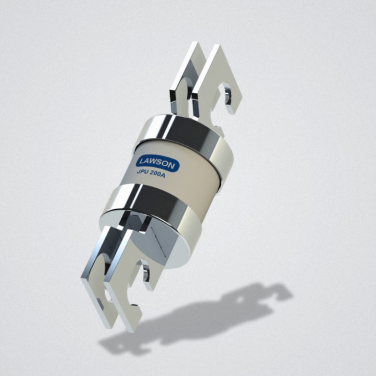
The most visible physical difference in the UK market is the traditional BS 88 knife-blade (or tag) contact fuse-link, sometimes called the ‘British Standard’ or ‘English’ form factor. This form factor was defined in the original BS 88 and remains in widespread use in UK industrial switchgear that was designed to accommodate it.
IEC 60269-2 defines several standard form factors but the knife-blade contact is not among the principal IEC forms. A knife-blade fuse-link is compliant with IEC 60269 in its electrical performance but carries BS 88 as the form-factor reference on the label. This is why you will sometimes see UK fuses marked with both references.
National annexes for legacy system compatibility
BS 88 includes informative national annexes that cover older British fuse systems — such as certain ratings and dimensions that pre-date the IEC harmonisation. These annexes exist for continuity in maintenance and retrofit applications. IEC 60269 does not include these annexes; it is a forward-looking international standard without the UK-specific legacy content.
Certification and third-party marks
In the UK, compliance with BS 88 is typically evidenced by ASTA certification or the BSI Kitemark. For IEC 60269, the equivalent marks include IECQ and the national certification marks of other countries (VDE in Germany, KEMA in the Netherlands, UL in the USA for the IEC-equivalent standard, etc.). All of these marks indicate independent third-party verification that the fuse-link has been tested to the standard — they do not indicate different performance levels.
Practical note: When specifying fuses for UK projects, ASTA certification against BS 88 / IEC 60269 remains the accepted benchmark. Lawson Fuses products are ASTA certified and dual-marked where applicable.
Side-by-side comparison
| Aspect | BS 88 (National) | IEC 60269 (International) |
|---|---|---|
| Issuing body | BSI (British Standards Institution) | IEC (International Electrotechnical Commission) |
| Geographical scope | United Kingdom | Worldwide (adopted by 80+ countries) |
| Relationship | National implementation document | Parent standard |
| Technical content | Identical in core requirements; UK-specific annexes for older systems | Sets all test methods, performance classes, and marking requirements |
| Utilisation categories | Same — gG, gM, aM, gR, gPV, etc. | Defined here; BS 88 adopts them unchanged |
| Voltage ratings | BS 88 covers systems up to 1000 V AC / 1500 V DC | IEC 60269 covers same range |
| ‘BS 88’ knife-blade contacts | Legacy form factor specific to UK market; covered by national annex | IEC does not mandate this form factor but does not prohibit it |
| Marking on fuse body | May show ‘BS 88-2’ or ‘IEC 60269-2’ | Shows ‘IEC 60269-x’ where x = part number |
| Certification | ASTA, BSI Kitemark | IECQ, national body marks (ASTA, VDE, UL, etc.) |
What this means for specification
For UK domestic projects
Specify BS 88 by part number (e.g. BS 88-2 for industrial HRC fuse-links). This is the conventional UK reference and will be understood by all UK switchgear manufacturers and contractors. A fuse-link marked BS 88-2 will also carry the IEC 60269-2 compliance mark.
For export or international projects
Specify IEC 60269 by part number with the relevant utilisation category (e.g. IEC 60269-2, gG, 400 V, 100 A). This ensures that suppliers in any country can source a compliant product. Do not rely solely on the BS 88 designation — while technically equivalent, not all international suppliers will recognise the BS number.
For multi-national projects or group specifications
Cite both references: ‘compliant with IEC 60269-2 (BS 88-2), utilisation category gG, rated voltage 400 V AC’. This removes ambiguity for all parties and is good practice in any contract document.
For solar PV projects
Use IEC 60269-6 (BS 88-6) for the gPV utilisation category. This part was published after the main harmonisation and explicitly covers the DC operating conditions and reverse-current requirements of photovoltaic string and combiner fusing.
Frequently asked questions
Can I use a fuse marked IEC 60269-2 in a switchboard designed to BS 88-2?
Yes — provided the fuse-link is the correct form factor, voltage rating, current rating, and utilisation category for the application. The electrical performance requirements are identical. If the switchboard uses a knife-blade fuse-base, the fuse must also be the knife-blade form factor, which will carry BS 88-2 as the form-factor reference.
My older fuses are marked ‘BS 88 Part 2’ without an IEC reference. Are they still compliant?
Fuses marked to the pre-harmonisation editions of BS 88 Part 2 were manufactured to a standard that has since been superseded. For maintenance replacements in existing equipment this is generally acceptable, but for new installations, specify fuses to the current edition (BS EN 60269-2 / IEC 60269-2:2022). Always check the installation’s own compliance documentation if in doubt.
Does the IEC 60269 edition matter?
Yes. The fifth edition (IEC 60269-1:2022) is the current standard. Earlier editions (2006, 1998) are technically superseded, though fuses certified to earlier editions are still in service worldwide. For new procurement, always specify or request compliance with the current edition.
Is there a BS 88 equivalent for semiconductor protection?
Yes — BS 88-4 is the UK implementation of IEC 60269-4, which covers fuse-links for semiconductor device protection (the aR and gR utilisation categories). These are specialised ultra-fast fuses and are a distinct product category from the gG and gM fuse-links used in general and motor circuit protection.
Summary
BS 88 and IEC 60269 are, for all practical engineering purposes, the same standard. BS 88 is the UK national publication; IEC 60269 is the international parent. Both define identical test methods, utilisation categories, performance classes, and marking requirements for low voltage HRC fuse-links.
The differences that remain — knife-blade form factors, legacy national annexes, certification marks — are matters of form, history, and regional convention rather than technical substance. A fuse-link that passes IEC 60269 testing passes BS 88 testing.
When writing specifications, use the reference appropriate to your market: BS 88 part number for UK work, IEC 60269 part number for international work, and both together for maximum clarity on complex projects.
About Lawson Fuses
Lawson Fuses has specialised in the design, development and manufacturing of low voltage HRC fuse-links and fuse-holders since 1938. Our products comply with IEC 60269 and BS 88 and are ASTA certified and ISO 9001 accredited. Lawson Fuses is an active member of the BSI and CENELEC technical committees that maintain these standards. For datasheets, compliance documentation, and technical guidance, visit www.lawsonfuses.com or call 01661 823 232.