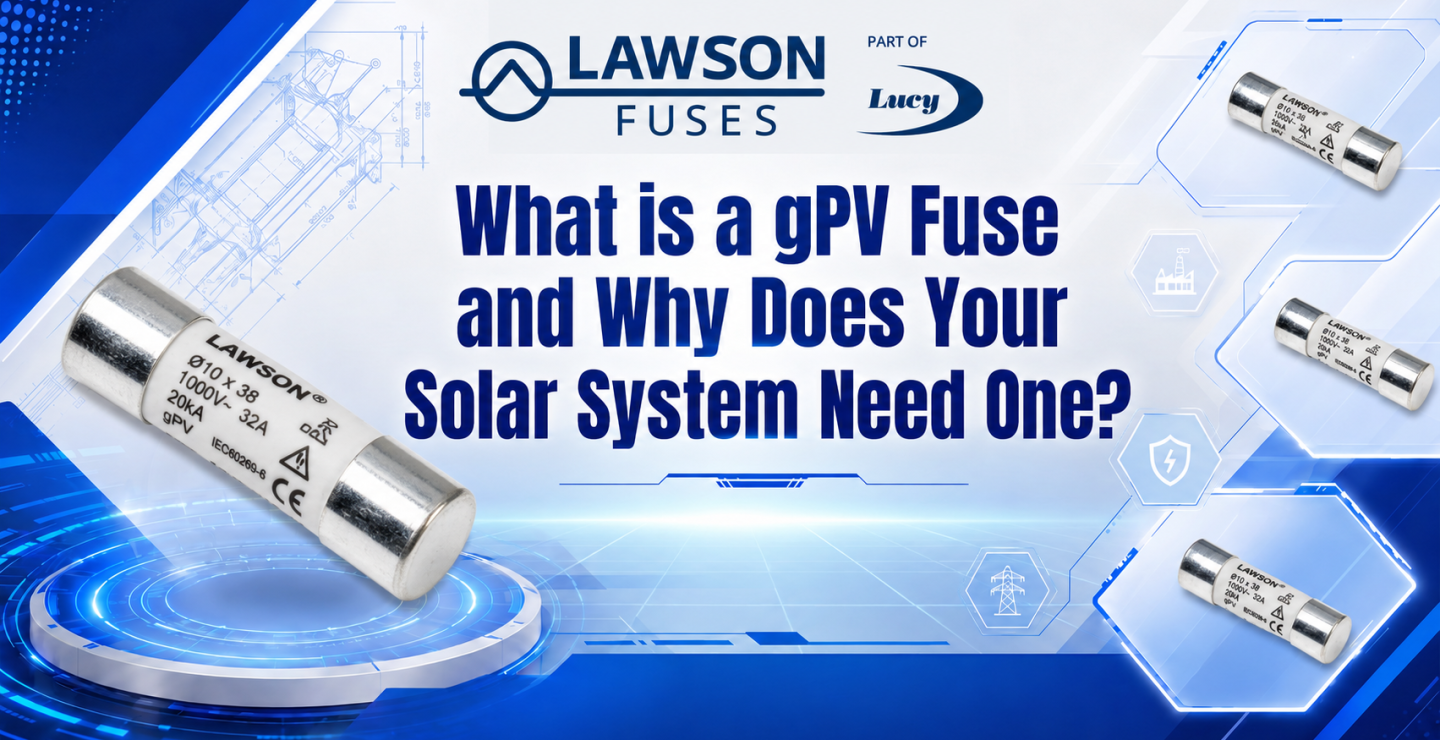
Key point: A gPV fuse is not simply a DC fuse in a different box. It is a separately certified protection device designed for the specific and demanding fault conditions of photovoltaic string arrays — conditions that standard DC fuses are not tested for and cannot reliably handle.
What Does gPV Actually Mean?
The designation gPV is a fuse utilisation category defined by IEC 60269-6 — the international standard dedicated entirely to fuse-links for photovoltaic energy systems. Every fuse conforming to this category carries the gPV marking on its body and datasheet, and every compliant installation specifying photovoltaic string protection should require it.
The two letters break down as follows:
g — Full-range breaking capacity. The lowercase “g” indicates that this fuse provides full-range overcurrent protection — it can safely interrupt any current from the minimum fusing current all the way up to its maximum rated breaking capacity. This distinguishes it from partial-range fuses (designated “a”), which only operate on higher-level short-circuit faults and require a separate overload protection device.
PV — Photovoltaic application. The “PV” designation confirms that this fuse is specifically designed, tested, and certified for use in photovoltaic energy system protection — not general purpose DC or AC circuits.
Together, gPV tells you that this fuse provides complete, full-range overcurrent protection specifically engineered and certified for the unique electrical environment of a solar PV string array.
The IEC 60269-6 Standard — What It Actually Requires
IEC 60269-6 is the part of the IEC 60269 international fuse standard series that addresses photovoltaic applications. While IEC 60269-1 covers general fuse requirements and IEC 60269-2 covers industrial fuses, IEC 60269-6 was developed specifically because the solar PV industry identified that no existing fuse standard adequately addressed the protection requirements of PV string arrays.
The standard defines performance requirements that a gPV fuse must meet, including:
Rated DC voltage — Fuses must be rated and tested at the actual DC system voltage of the application — either
1000V DC for conventional PV systems or 1500V DC for high-voltage utility-scale systems. Not extrapolated, not assumed — actually tested.
Low overcurrent interruption — This is the most distinctive requirement in IEC 60269-6. The gPV fuse must demonstrate the ability to detect and interrupt fault currents at approximately 1.35 to 1.5 times the string rated short-circuit current (Isc). These characteristically low overcurrents — far below what standard fuses are designed to detect — are the signature fault condition of PV string arrays.
Reverse current interruption — The fuse must reliably interrupt current flowing in the reverse direction through a faulted string — a condition unique to PV arrays and not present in conventional DC power systems.
DC arc interruption at rated voltage — At the full rated voltage (1000V DC or 1500V DC), the fuse must safely extinguish the DC arc that forms when the fuse element melts. This is significantly more demanding than AC arc extinction because DC circuits have no natural current zero-crossing to aid arc suppression.
Environmental performance — The standard includes temperature cycling, humidity, and altitude requirements reflecting the demanding outdoor environments in which PV combiner boxes and junction boxes are installed.
A fuse carrying IEC 60269-6 certification has been independently tested against all of these requirements. A fuse without this certification — regardless of its voltage rating or current rating — has not been.
Why Standard DC Fuses Cannot Do This Job
This is the question that arises most often in solar project design, particularly when procurement teams are looking for cost savings: why can’t a standard DC fuse — perhaps one already used elsewhere on the project — be used for PV string protection?
The answer comes in two parts.
The Voltage Problem
Most conventional DC fuses are rated for voltages far below 1000V DC. Industrial DC applications — battery systems, rectifiers, DC drives — commonly operate at 24V DC, 48V DC, 110V DC, or 250V DC. Even where higher DC voltage ratings exist, they have been tested for the arc conditions of those specific applications, not for the 1000V DC or 1500V DC open-circuit voltages of a solar PV string.
A fuse rated for 600V DC may appear to carry enough voltage margin for a 1000V DC system — but it has not been tested to safely interrupt a DC arc at 1000V DC, and it is not certified for that duty. Under a fault, the arc energy at 1000V DC may overwhelm the fuse’s arc-quenching capability, leading to sustained arcing, fuse body rupture, or fire.
The Low Overcurrent Problem
Even setting voltage rating aside, standard DC fuses are not designed to operate at the low overcurrent levels characteristic of PV string faults.
In a conventional DC system, a short-circuit fault produces a fault current that is very many times the normal operating current — easily within the range any reasonable fuse will detect and interrupt. But in a multi-string PV array, the fault currents associated with reverse current faults and multi-array faults are extremely modest — often only 1.35 to 1.5 times the string’s own Isc.
At these low multiples, a standard gG or general-purpose DC fuse will not operate. Its time-current characteristic is not designed for these conditions. The fuse sits there, apparently intact, while the faulted string cable and panels are carrying fault current they are not rated for — potentially for hours, days, or indefinitely.
This is the scenario that IEC 60269-6 was written to address, and it is why only a certified gPV fuse provides compliant protection for PV string arrays.
The Comparison in Plain Terms
| Feature | Standard DC Fuse | gPV Fuse (IEC 60269-6) |
| Rated for 1000V DC or 1500V DC operation | Rarely | Yes — tested and certified |
| Tested for DC arc interruption at PV voltages | No | Yes |
| Detects low overcurrents (~1.35–1.5 × Isc) | No | Yes — core requirement of IEC 60269-6 |
| Protects against reverse current faults | No | Yes |
| Protects against multi-array faults | No | Yes |
| Compliant with IEC 62548 (PV array design) | No | Yes |
| Suitable for PV string protection | No | Yes |
Which Solar Installations Need a gPV Fuse?
The short answer is: any solar PV installation where two or more strings are connected in parallel to the same inverter MPPT input or DC bus.
Single-string, single-MPPT systems — where one string connects directly to one inverter input with no parallel path — do not require string fusing, because there is no return path through which reverse current can flow. The inverter’s own internal protection handles fault conditions.
Multi-string systems — the majority of commercial rooftop installations, all utility-scale solar farms, and many residential systems with microinverters or optimisers at sub-array level — require one gPV fuse per positive string conductor, installed in the combiner box or junction box between the string and the DC bus.
In practical terms, this means a gPV fuse is required in:
- All solar combiner boxes aggregating two or more strings
- String junction boxes where multiple strings feed a single inverter MPPT input
- DC bus fusing at the output of multi-array combiner boxes
- Any 1500V DC utility-scale solar farm with parallel string connections
How to Identify a Genuine gPV Fuse
When specifying or procuring solar panel fuses for any PV installation, look for the following on the product body and datasheet:
The gPV marking — The utilisation category gPV should be clearly marked on the fuse body alongside the rated voltage and current rating. If it is not marked, the fuse is not a certified gPV type.
IEC 60269-6 certification — The datasheet should explicitly reference compliance with IEC 60269-1 and IEC 60269-6. Vague references to “DC rated” or “solar compatible” without the IEC 60269-6 citation are not sufficient.
Rated DC voltage — The voltage rating should be clearly marked as a DC voltage — either 1000V DC or 1500V DC — not an AC voltage or an ambiguous combined rating.
CE marking — For products placed on the European and UK market, CE marking confirms that the manufacturer has declared compliance with applicable directives and standards.
Manufacturer certification — Specify a gPV fuse from a manufacturer operating under an ISO 9001 accredited quality management system with test facilities accredited to ISO/IEC 17025. This provides confidence that the certified performance is consistently achieved in production, not just in the test laboratory.
The Lawson LFPV-32 (1000V DC, 10x38mm, 1A–32A) and LFPV-35 (1500V DC, 10x85mm) carry all of the above markings and certifications, and are manufactured at Lawson’s UK facility under ISO 9001 accreditation with ISO/IEC 17025-accredited test facilities.
Does a gPV Fuse Cost More Than a Standard DC Fuse?
In absolute terms, a certified gPV fuse will typically carry a modest cost premium over an uncertified general-purpose DC fuse of the same current rating. In the context of a complete solar PV installation, this premium is trivial relative to the cost of panels, inverters, mounting systems, installation labour, and grid connection.
The relevant comparison is not fuse cost versus fuse cost. It is the cost of a correctly specified, certified gPV fuse versus the cost of a sustained reverse current fault in an unprotected string — potentially causing cable damage, panel damage, combiner box fire, and system downtime that can run into thousands of pounds per day on a commercial installation.
Specified correctly, a gPV fuse is one of the least expensive components in a solar PV protection system. Not specifying it correctly is one of the more expensive mistakes.
Frequently Asked Questions
Q: Is a gPV fuse the same as a solar fuse?
The terms are used interchangeably in the industry — a solar fuse, solar DC fuse, PV fuse, and photovoltaic fuse all refer to the same thing: a fuse-link certified to IEC 60269-6 for photovoltaic string protection. The gPV designation is the formal IEC utilisation category name. When someone refers to a solar fuse or PV fuse, they should mean a gPV-certified product to IEC 60269-6.
Q: Can I use a gG fuse instead of a gPV fuse in a solar system?
No. A gG fuse is a general purpose fuse designed for cable protection in AC and some DC circuits. It is not tested or certified for the low overcurrent conditions of PV string faults (reverse current, multi-array fault), and it is not rated for 1000V DC or 1500V DC operation. Using a gG fuse in a solar PV string is non-compliant with IEC 62548 and leaves the installation unprotected against the characteristic fault types of PV arrays.
Q: Do I need a gPV fuse on every string?
One gPV fuse per positive string conductor is required in any configuration where two or more strings are connected in parallel. In a single-string system, string fusing is not required. Always check the inverter manufacturer’s wiring guidelines and the applicable installation standard for your country.
Q: What current rating should a gPV fuse be?
The gPV fuse current rating must be: greater than or equal to 1.25 × the panel Isc (to avoid nuisance tripping at peak irradiance), and less than or equal to the minimum of the cable current-carrying capacity and the panel’s maximum reverse current rating (Irev max). A worked calculation example is provided in our Complete Guide to Solar DC Fuses and PV String Protection.
Q: Does a gPV fuse work in both 1000V DC and 1500V DC systems?
No. A gPV fuse is rated for a specific DC voltage — either 1000V DC or 1500V DC. A 1000V DC-rated gPV fuse must never be used in a 1500V DC system. The fuse must be selected to match the system’s maximum DC operating voltage. See our guide: 1000V DC vs 1500V DC Solar Fuse — What’s the Difference?
Summary
A gPV fuse is the only fuse type tested and certified to protect photovoltaic string arrays against the specific fault conditions they face — reverse current faults and multi-array faults producing low overcurrents at high DC voltages. Standard DC fuses are not designed for these conditions and do not provide compliant protection.
Specifying a certified gPV fuse to IEC 60269-6 for every multi-string solar PV installation is not optional. It is the difference between a protection system that works and one that appears to work until the moment it matters most.
Summary
A gPV fuse is the only fuse type tested and certified to protect photovoltaic string arrays against the specific fault conditions they face — reverse current faults and multi-array faults producing low overcurrents at high DC voltages. Standard DC fuses are not designed for these conditions and do not provide compliant protection.
Specifying a certified gPV fuse to IEC 60269-6 for every multi-string solar PV installation is not optional. It is the difference between a protection system that works and one that appears to work until the moment it matters most.