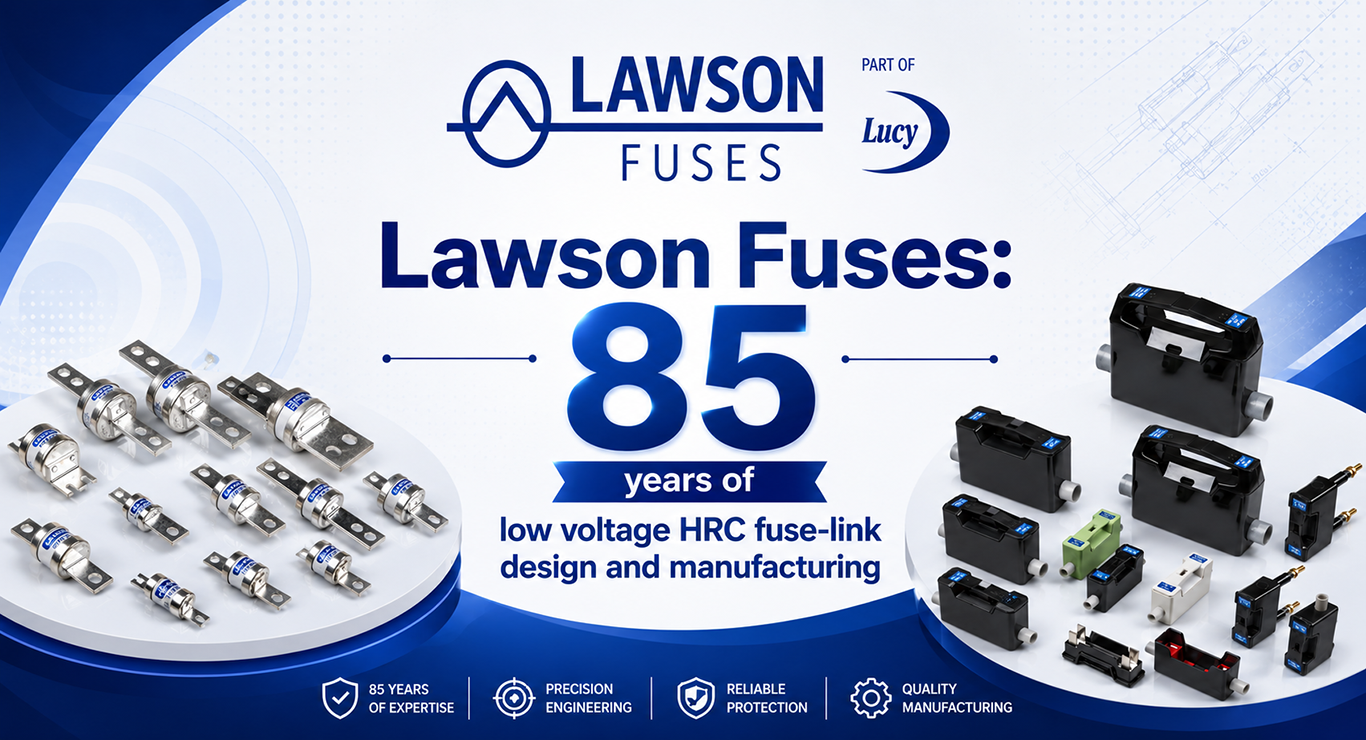
Not many manufacturers can trace a continuous line from their founding to the present day across eight decades of industrial change. Lawson Fuses can. Since 1938, the company has designed and manufactured low voltage HRC fuse-links at its Newcastle upon Tyne facility — through post-war reconstruction, the electrification of British industry, the North Sea oil boom, the shift to renewable energy, and now the emergence of electric vehicle infrastructure and battery storage.
That continuity is not simply a matter of company history. It reflects something more substantive: a depth of manufacturing knowledge, testing capability, and standards expertise that takes decades to accumulate and cannot be acquired off a shelf. This article traces the story of Lawson Fuses, explains what 85 years of specialism means in practice for engineers and procurement teams, and sets out why UK-manufactured HRC fuse-links continue to matter in a global supply market.
Founded in 1938: the context
Lawson Fuses was established in Newcastle upon Tyne in 1938, at a moment when the electrification of British industry was accelerating rapidly. The grid was expanding, factories were converting from direct drive to electric motor systems, and the demand for reliable, high-performance protective devices was growing faster than the existing supply could meet.
The HRC fuse-link — high rupturing capacity, filled with silica sand, capable of safely interrupting the very high fault currents that the new grid infrastructure could deliver — was a relatively recent engineering development. Lawson was among the early specialists, focusing from the outset on the design and manufacture of fuse-links that could be trusted in the demanding environment of heavy industry.
Newcastle and the surrounding North East was, at that time, one of the industrial heartlands of the UK — shipbuilding, steel, mining, and engineering. The local market was large, the technical requirements were exacting, and the culture of precision manufacturing that characterised the region shaped Lawson’s approach from the beginning.
Eight decades: a timeline of key milestones
| Year | Event / Milestone | Description |
|---|---|---|
| 1938 | Company Founded as Lawson Beck Ltd | Collaborative effort to find solutions to some true company problems |
| 1939 | Second World War | Production of aircraft fuses under direction of industry program |
| 1944 | Pullcap Fuses | Fuse-holder range patented in the UK and several other countries |
| 1947 | Post War Electrification | Participation in the UK postwar electrification program |
| 1950 | Company Name Changes | Company name changed to Lawson Fuses |
| 1960 | Greenfield Site | Business moved to a Greenfield site in Ponteland, Newcastle |
| 1979 | Direct Exports | Direct exports commence |
| 1980’s | Products Accreditation | Products accredited to the ASTA 20 in 1982 and Authorisation Scheme Company independently accredited to quality standard BS5750 (now ISO9001) in 1989 |
| 1996 | Standard Electricals Ltd of Delhi | The Company joins with Standard Electricals Ltd of Delhi, India, to form a 50/50 Joint Venture Company, Standard Lawson Fusegear Ltd, located in Delhi |
| 2003 | Lawson Fuses India Ltd. | Joint Venture Company dissolved with Lawson Fuses Ltd taking control and renaming the Company Lawson Fuses India Ltd. |
| 2018 | Lucy Group | Lawson Fuses acquired by Lucy Group |
| 2020 | Relocation to Vadodara | Lawson Fuses India manufacturing facility relocates to Vadodara, India, close to Lucy Electric facility and changes its name to Lawson Lucy India Private Limited |
What UK manufacturing means for product quality
The decision to maintain manufacturing in the UK — specifically at the Newcastle facility — is not purely a matter of heritage. It has direct implications for product quality, traceability, and technical support that matter to engineers and procurement managers specifying protective devices for critical applications.
In-house design and testing
Lawson holds ISO/IEC 17025 accreditation for its in-house test laboratory. This means the laboratory’s technical competence has been independently assessed and verified by UKAS — the UK’s national accreditation body. Fuse-links are tested in the same facility where they are designed and manufactured, by engineers who understand both the product and the test requirements in depth.
This integration of design, manufacture, and test under one roof is increasingly rare. Many fuse products sold in the UK are designed by one company, manufactured by contract producers in multiple countries, and tested by third-party facilities with no ongoing relationship with the designer. The traceability from test certificate to product batch to manufacturing process is correspondingly weaker.
ASTA certification and standards committee membership
Lawson fuse-links carry ASTA product certification — independent third-party verification that the products meet the requirements of IEC 60269 and BS 88. ASTA is the Association of Short-circuit Testing Authorities, and its certification mark is the accepted standard for HRC fuse-links in UK and export markets.
Beyond certification, Lawson participates actively in the BSI and CENELEC technical committees (TC32) that write and maintain the standards to which its products are certified. This means the company’s engineering team engages with the development of IEC 60269 and BS 88 directly — contributing to the standards rather than simply reacting to them. For engineers specifying Lawson products, this is a meaningful quality signal: the manufacturer understands the standards from the inside.
Traceability and supply chain transparency
UK manufacturing provides a level of supply chain traceability that is difficult to achieve with offshore production. Each Lawson fuse-link can be traced back through manufacturing batch records to the raw materials — silver element wire, ceramic body, silica sand filler, end-cap materials — with documented quality control at each stage. For applications in power utilities, defence, or safety-critical infrastructure, this traceability is not optional.
Accreditations and certifications
| Accreditation / Standard | Issuing Body | What It Covers |
|---|---|---|
| ASTA product certification | ASTA (Association of Short-circuit Testing Authorities) | Independent third-party verification that fuse-links meet IEC 60269 / BS 88 performance requirements |
| ISO 9001:2015 | BSI / UKAS-accredited certification body | Quality management system across design, manufacturing, testing, and supply chain |
| ISO/IEC 17025 | UKAS | Technical competence of Lawson’s in-house test laboratory for electrical testing |
| IEC 60269 / BS 88 | IEC / BSI | Core low voltage fuse-link standard — all Lawson LV products comply |
| RoHS compliance | EU Directive 2011/65/EU | Restriction of hazardous substances in electrical equipment |
| REACH compliance | ECHA (European Chemicals Agency) | Responsible use of chemical substances in product manufacture |
| BSI / CENELEC committee membership | BSI TC / CENELEC TC32 | Active participation in the committees that write and maintain the standards Lawson products are certified to |
The product range: breadth from a specialist
Specialisation does not mean a narrow product range. Eight decades of responding to industrial requirements have produced a comprehensive portfolio of fuse-link types and ratings:
gG general purpose fuse-links
The core of the Lawson range. Full-range general purpose fuse-links to IEC 60269-2 and BS 88-2, covering the standard current ratings and voltage levels used in LV industrial switchgear, distribution boards, and motor control centres. Available in BS 88 knife-blade contact and NH (DIN) form factors.
gM motor circuit fuse-links
Full-range fuse-links with an extended overload tolerance, designed to ride through motor starting inrush without nuisance tripping. Selected in place of gG on motor branch circuits, sized to the motor’s full-load current.
Semiconductor protection fuse-links (aR / gR)
Ultra-fast fuse-links for the protection of thyristors, IGBTs, diodes, and other semiconductor devices in variable-speed drives, UPS systems, and power converters. Characterised by very low pre-arcing I²t values to limit the energy let-through to levels that semiconductor junctions can survive.
gPV solar PV fuse-links
DC-rated fuse-links to IEC 60269-6 and BS 88-6 for the protection of solar photovoltaic string and combiner circuits. Available in 600 V DC, 1000 V DC, and 1500 V DC ratings. Engineered for the sustained DC arc interruption and reverse current tolerance requirements specific to PV arrays.
NH (DIN) fuse-links
The international standard form factor for LV switchgear. NH fuse-links in sizes 000 through 3, covering the full range of current ratings used in main LV distribution switchgear, transformer secondary protection, and industrial distribution boards.
Custom and bespoke fuse-links
For applications that fall outside the standard range — non-standard current ratings, specialist environmental specifications, unusual form factors, or requirements driven by defence, aerospace, or EV charging infrastructure — Lawson’s engineering team designs and manufactures custom fuse-links. This capability is a direct product of the in-house design and test facility: bespoke products can be developed, tested, and certified without dependence on external partners.
Markets served
| Market | Typical Lawson Products | Key Requirement |
|---|---|---|
| Industrial manufacturing | gG, gM fuse-links; NH fuse-links; fuse-holders | High breaking capacity; reliable overload protection; long service life |
| Power utilities & distribution | NH fuse-links; HRC fuse-links for LV switchgear | High fault withstand; compliance with utility specifications |
| Renewable energy (solar PV) | gPV fuse-links (IEC 60269-6); DC-rated products | DC interruption capability; reverse current tolerance; temperature derating |
| Motor control & drives | gM fuse-links; semiconductor (aR) fuse-links | Inrush tolerance for gM; ultra-fast I²t response for semiconductor protection |
| Commercial & infrastructure | gG fuse-links; fuse-holders and accessories | Compact form factor; high breaking capacity relative to device size |
| Export / OEM | Custom-rated fuse-links; dual-marked products | Compliance with both BS 88 and IEC 60269; export documentation |
| Custom / defence / EV | Bespoke fuse-link designs | Non-standard ratings, form factors, or environmental specifications |
Exporting British manufacturing expertise
Lawson fuse-links are exported to more than 50 countries across six continents. This reach is built on a combination of product quality, standards compliance, and the practical advantage that IEC 60269 — the international standard to which Lawson products are certified — is recognised and accepted in every major electrical market worldwide.
For international OEM customers and project specifiers, Lawson can provide dual-marked products (BS 88 and IEC 60269), export documentation, and technical support aligned with the requirements of specific markets. The Newcastle manufacturing base provides a single traceable source of supply regardless of destination.
Lawson Fuses products have been installed in power distribution infrastructure, industrial plant, and renewable energy projects on every inhabited continent. The consistency of quality and certification compliance that UK manufacturing enables is a key reason why international customers return to Lawson as a long-term supply partner.
Looking forward: the next chapter
The electrical industry is changing faster than at any point since the original electrification of industry in the early twentieth century. The transition to renewable generation, the mass adoption of electric vehicles, the proliferation of battery energy storage systems, and the increasing density of power electronics in industrial and commercial buildings are all creating new demands on protective devices.
Lawson’s response to these changes follows the same pattern established over 85 years: understand the engineering requirement in depth, develop products that meet it precisely, test them to the relevant standard, and support customers in applying them correctly. The gPV range for solar PV, the reduced-silver element technology for sustainability, and the growing custom engineering capability for EV and defence applications are all expressions of this approach.
The fundamentals of HRC fuse-link engineering — the relationship between element geometry, silica sand filler, arc energy, and I²t let-through — have not changed since 1938. What has changed is the range of applications those fundamentals must serve. Lawson Fuses, after 85 years of continuous development, is well placed to serve all of them.
Lawson Fuses
Lawson Fuses is an independent specialist manufacturer of low voltage HRC fuse-links and fuse-holders, based in Newcastle upon Tyne and part of the Lucy Group. Products are ASTA certified and comply with IEC 60269 and BS 88. ISO 9001 and ISO/IEC 17025 accredited. For the full product range, datasheets, and technical support, visit www.lawsonfuses.com or call 01661 823 232.