Quick Summary: A solar DC fuse is not the same as a standard DC fuse. This guide explains exactly what a photovoltaic fuse is, why you need a certified gPV fuse for PV string protection, how to select the right current rating, and which fuse holder to use — covering both 1000V DC and 1500V DC solar systems.
Table of Contents
- What is a Solar DC Fuse?
- Why Standard DC Fuses Are Not Suitable for Solar PV Systems
- What is a gPV Fuse? Understanding IEC 60269-6
- The Two Main PV Fault Types Your Solar Fuse Must Protect Against
- 1000V DC vs 1500V DC Solar Fuse — Understanding the Difference
- How to Select the Right PV Fuse Current Rating
- 10x38mm Solar Fuse — The Industry Standard Format Explained
- PV Fuse Holder Selection — 10×38, 14×51 and 22×58 Formats
- Where to Install Solar Panel Fuses in a PV System
- Solar Fuse Specifications — What to Check Before You Buy
- Frequently Asked Questions
1. What is a Solar DC Fuse?
A solar DC fuse — also called a PV fuse, photovoltaic fuse, or DC string fuse — is a fuse-link specifically designed and certified for the protection of photovoltaic string arrays in solar power installations. Unlike a standard AC or general-purpose DC fuse, a solar DC fuse must meet a unique set of electrical and mechanical requirements that are specific to the fault conditions encountered in solar PV systems.
At its simplest, a solar DC fuse sits between a PV string (a series-connected row of solar panels) and the combiner box, protecting both the string wiring and the panels themselves from the consequences of overcurrent faults. When a fault occurs — whether that is a reverse current fault from an adjacent string, a multi-array fault, or a short circuit in the combiner box wiring — the solar DC fuse must detect and interrupt the fault current before it can cause cable damage, fire risk, or panel failure.
This sounds straightforward. But the electrical environment of a solar PV system makes fuse selection significantly more complex than in conventional AC or DC power systems — which is why a dedicated, certified photovoltaic fuse is always required.
2. Why Standard DC Fuses Are Not Suitable for Solar PV Systems
This is one of the most important and most frequently misunderstood points in solar PV protection design: you cannot use a standard DC fuse in a solar PV application. Here is why.
The DC Arc Problem
Unlike AC circuits, which have a natural current zero-crossing every half cycle (100 times per second on a 50Hz supply), DC circuits maintain a continuous current flow with no natural zero. This means that when a fuse operates in a DC circuit, the resulting arc does not extinguish naturally at a current zero — it must be actively quenched by the fuse design itself.
A solar DC fuse operates at voltages up to 1000V DC or 1500V DC — far higher than most general-purpose DC fuse ratings. At these voltages, DC arc interruption is an exceptionally demanding engineering challenge. A fuse not specifically designed and tested for these voltages may fail to interrupt the arc safely, leading to sustained arcing, fire, or explosive fuse failure.
The Low Overcurrent Problem
The second — and arguably more insidious — problem is the fault current magnitude in PV systems.
In conventional electrical systems, a short-circuit fault produces a fault current that is many times larger than the circuit’s normal operating current. This makes it relatively easy for a fuse to detect and operate on the fault.
In a PV string array, however, the characteristic fault currents associated with reverse current faults and multi-array faults are very low — typically only 1.35 to 1.5 times the string’s rated short-circuit current (Isc). This is far below the operating threshold of a standard general-purpose DC fuse, which may simply not operate at all under these conditions.
The consequence is that a solar PV string could remain in a faulted condition — with one string feeding fault current back into another — indefinitely, with the standard DC fuse providing no protection at all.
Only a dedicated gPV fuse to IEC 60269-6, specifically designed and tested for these low overcurrent conditions, can provide reliable protection.
Summary — Why Standard DC Fuses Fail in Solar PV:
| Issue | Standard DC Fuse | Solar DC Fuse (gPV) |
| Voltage rating | Typically ≤ 600V DC | 1000V DC or 1500V DC |
| Arc interruption at high DC voltage | Not tested | Tested and certified to IEC 60269-6 |
| Low overcurrent fault detection | Not rated for ~1.35–1.5 × Isc | Specifically tested for PV fault currents |
| Reverse current protection | No | Yes |
| Multi-array fault protection | No | Yes |
3. What is a gPV Fuse? Understanding IEC 60269-6
A gPV fuse is a fuse-link conforming to the utilisation category gPV as defined by IEC 60269-6 — the international standard specifically dedicated to fuse-links for the protection of photovoltaic energy systems.
The gPV designation breaks down as follows:
- g — Full-range breaking capacity. The fuse can interrupt any current from the minimum fusing current up to the rated breaking capacity. This covers both overload and short-circuit conditions across the complete range.
- PV — Photovoltaic. The fuse is specifically designed, tested, and certified for use in photovoltaic string array protection applications.
A gPV fuse is the only utilisation category that is tested to the specific operating requirements of PV systems — including the ability to interrupt the low-level overcurrents of reverse current and multi-array faults at the full rated DC system voltage.
What IEC 60269-6 Requires
IEC 60269-6 defines the performance requirements that a solar DC fuse must meet, including:
- Operation at rated voltages of 1000V DC and 1500V DC
- Demonstrated ability to interrupt low overcurrents in the range of approximately 35–1.5 × Isc characteristic of PV string faults
- Confirmed breaking capacity at the full rated DC voltage under worst-case power factor conditions
- Physical dimensional requirements for the fuse-link body and contacts
- Thermal and environmental performance under solar installation conditions
When you specify a photovoltaic fuse for a solar PV installation, it should always carry certification to IEC 60269-1 and IEC 60269-6, and ideally be CE marked. Never install an uncertified fuse in a PV string — the consequences of fuse failure in a solar PV system can include fire, panel damage, and prolonged system downtime.
4. The Two Main PV Fault Types Your Solar Fuse Must Protect Against
Understanding why you need a certified solar DC fuse requires understanding the specific fault types that occur in photovoltaic string arrays.
Fault Type 1: Reverse Current Fault
A reverse current fault occurs when one string in a multi-string PV array becomes faulted — for example, through shading, cell damage, bypass diode failure, or open-circuit conditions — and the remaining healthy strings in the array drive current backwards through the faulted string.
The fault current in this scenario is the sum of the short-circuit currents from all the parallel strings minus the faulted string. Depending on the number of strings in the array, this can be a relatively modest overcurrent — but it flows in the reverse direction through the faulted string’s cabling and panels, which can cause serious overheating of the string cable, combiner box wiring, and the panels themselves.
The solar DC fuse in the faulted string must detect and interrupt this reverse current before damage occurs. A gPV fuse is specifically designed to operate reliably at the low overcurrent magnitudes associated with reverse current faults in multi-string arrays.
Fault Type 2: Multi-Array Fault
A multi-array fault occurs when a fault develops at the combiner box output or main DC bus, drawing fault current from multiple PV arrays simultaneously. The total fault current can be the combined Isc from all strings in all arrays connected to the fault point — and the individual string fuses in each array must operate to isolate the source of fault current.
Again, the individual PV fuse per string sees only a fraction of the total fault current — making the low-overcurrent operating capability of a certified gPV fuse critical for effective protection.
5. 1000V DC vs 1500V DC Solar Fuse — Understanding the Difference
Modern solar PV systems are available in two principal DC voltage architectures: 1000V DC and 1500V DC. These require different solar DC fuses, and the distinction is critical.
1000V DC Solar Fuse
The 1000V DC solar fuse is the established standard for conventional photovoltaic string systems. Systems designed to a 1000V DC maximum string voltage have been the industry standard for residential rooftop solar, commercial rooftop installations, and smaller ground-mount systems for many years.
The Lawson Type LFPV-32 is a certified 1000V DC solar fuse in the standard 10x38mm cylindrical format, available in 13 current ratings from 1A to 32A. It is certified to IEC 60269-1 and IEC 60269-6 with a gPV utilisation category and a 20kA DC breaking capacity.
Key specifications:
| Parameter | LFPV-32 (1000V DC) |
| Rated Voltage | 1000V DC |
| Format | 10 x 38mm cylindrical |
| Current Ratings | 1A, 2A, 3A, 4A, 5A, 6A, 8A, 10A, 12A, 15A, 20A, 25A, 32A |
| Breaking Capacity | 20kA DC |
| Power Dissipation | 3.5W max |
| Cable Connection | 2.5mm² – 10mm² |
| Working Temperature | -30°C to +70°C |
| IP Rating | IP20 |
| Max Altitude | 2000m |
| Standard | IEC 60269-1 / IEC 60269-6 |
| Mounting | Class III / DIN rail (35mm) |
1500V DC Solar Fuse
The 1500V DC solar fuse is the newer, higher-voltage format required for the latest generation of high-voltage PV architecture. 1500V DC systems have become increasingly prevalent in utility-scale solar farms and large commercial installations because they allow longer string lengths, fewer combiner boxes, and reduced balance-of-system costs compared to 1000V DC architecture.
However, 1500V DC systems cannot use 1000V DC fuses. The higher system voltage demands a fuse specifically rated, designed, and tested for 1500V DC arc interruption. The Lawson Type LFPV-35 is a certified 1500V DC solar fuse in a 10x85mm format — the longer body accommodating the greater arc-energy requirements at 1500V DC.
Key Differences at a Glance
| Feature | 1000V DC Solar Fuse | 1500V DC Solar Fuse |
| System voltage | Up to 1000V DC | Up to 1500V DC |
| Typical fuse format | 10 x 38mm | 10 x 85mm |
| Typical applications | Residential, commercial rooftop, small ground-mount | Large commercial, utility-scale solar farms |
| Lawson product | LFPV-32 | LFPV-35 |
| Interchangeable? | No — never substitute a 1000V fuse in a 1500V system | — |
Critical safety point: A 1000V DC solar fuse must never be installed in a 1500V DC system. The arc energy at 1500V DC will overwhelm a 1000V rated fuse, leading to catastrophic fuse failure, sustained arcing, and potential fire risk. Always verify the system maximum open-circuit voltage (Voc) before selecting your solar DC fuse.
6. How to Select the Right PV Fuse Current Rating
Selecting the correct current rating for your PV fuse is one of the most important decisions in solar PV protection design. The following process applies to string-level fusing in multi-string combiner box applications.
Step 1: Determine the Panel Isc
Find the short-circuit current (Isc) of your solar panels from the manufacturer’s datasheet. This is the maximum current the panel can produce under standard test conditions (STC: 1000 W/m², 25°C, AM1.5G).
Step 2: Apply the Temperature Correction
Real-world operating conditions — particularly high ambient temperatures and high irradiance — can push the actual Isc above the STC value. IEC 61730 and IEC 61215 allow for a temperature correction factor. As a general rule, multiply the STC Isc by 1.25 to determine the corrected operating Isc.
Corrected Isc = Isc (STC) × 1.25
Step 3: Determine the Maximum Reverse Current
In a multi-string array with N parallel strings, the maximum reverse current that a single faulted string can experience is the combined Isc from all other (N-1) strings:
Max reverse current = (N – 1) × Corrected Isc
This is the worst-case current the solar DC fuse in the faulted string must carry and interrupt.
Step 4: Check the Panel’s Maximum Reverse Current Rating
Solar panel manufacturers specify a maximum reverse current (Irev max) in the panel datasheet — this is the maximum reverse current the panels can tolerate without damage. In most cases, this figure determines the upper limit for fuse selection.
Step 5: Select the Fuse Rating
The PV fuse current rating (In) must satisfy all of the following:
- In ≥ 1.25 × Isc (the fuse must not nuisance-trip on normal operating current)
- In ≤ Irev max of the panel (the fuse must protect the panel from reverse current damage)
- In ≤ cable current-carrying capacity (the fuse must protect the string cable)
Choose the closest standard rating that satisfies all three conditions. For most conventional residential and commercial solar panels with an Isc in the 9A–13A range, a 10A or 15A solar DC fuse in the 10x38mm format is typically appropriate. For higher-power panels with Isc above 13A, a 20A or 25A rating may be required.
Worked Example
- Solar panel Isc (STC): 9.8A
- Corrected Isc: 9.8 × 1.25 = 25A
- Number of parallel strings: 4
- Max reverse current: (4 – 1) × 12.25 = 75A
- Panel Irev max: 20A
- String cable current-carrying capacity: 20A
Fuse selection: In must be ≥ 12.25A and ≤ 20A. Select the 15A LFPV-32 solar DC fuse.
7. 10x38mm Solar Fuse — The Industry Standard Format Explained
The 10x38mm solar fuse (also written 10×38 or Ø10×38) is the dominant cylindrical fuse format for PV string protection worldwide. The designation refers to the physical dimensions of the cylindrical fuse-link body: 10mm in diameter and 38mm in length.
This format is used for the Lawson LFPV-32 1000V DC solar fuse and is compatible with the widest range of PV fuse holders, combiner boxes, and junction box fuse assemblies in the global solar industry.
Why the 10x38mm Format is Universal in Solar PV
The 10x38mm format was adopted as the standard for PV string fusing for several practical reasons:
Physical size — At 10mm diameter and 38mm length, the fuse is compact enough to fit within standard combiner box and junction box fuse holder assemblies without requiring additional panel space, yet large enough to carry the current ratings (1A–32A) required for most PV string applications.
Electrical suitability — The 10x38mm body size provides sufficient internal volume for the arc-quenching filling material (quartz sand) to safely extinguish DC arcs at 1000V DC with a 20kA breaking capacity.
Compatibility — The 10x38mm format is compatible with a wide range of PV fuse holders from multiple manufacturers, simplifying sparing and maintenance.
The 10×38 Fuse vs the 10x85mm 1500V Fuse
For 1500V DC systems, the 10x85mm format (as used in the Lawson LFPV-35) replaces the 10x38mm. The longer body — 85mm versus 38mm — is required to accommodate the greater arc-energy at 1500V DC. The two formats are not interchangeable: a 10x38mm fuse must never be installed in a 10x85mm fuse holder, and vice versa.
8. PV Fuse Holder Selection — 10×38, 14×51 and 22×58 Formats
The PV fuse holder is as important as the fuse-link itself. A fuse holder not rated for the DC system voltage, not suitable for outdoor or enclosure environments, or not correctly sized for the fuse-link format will compromise the protection system regardless of the quality of the fuse.
Why You Need a Dedicated PV Fuse Holder
Standard AC fuse holders — even those rated for the same current — are not suitable for solar DC applications. DC arc interruption at 1000V or 1500V DC requires greater contact separation, higher dielectric strength, and a fuse holder body designed to safely contain the energy released when a solar DC fuse operates. A PV fuse holder must be specifically rated for DC voltage at the system level (1000V DC or 1500V DC).
Fuse Holder Size Selection
The three principal cylindrical fuse holder sizes used in solar PV applications are:
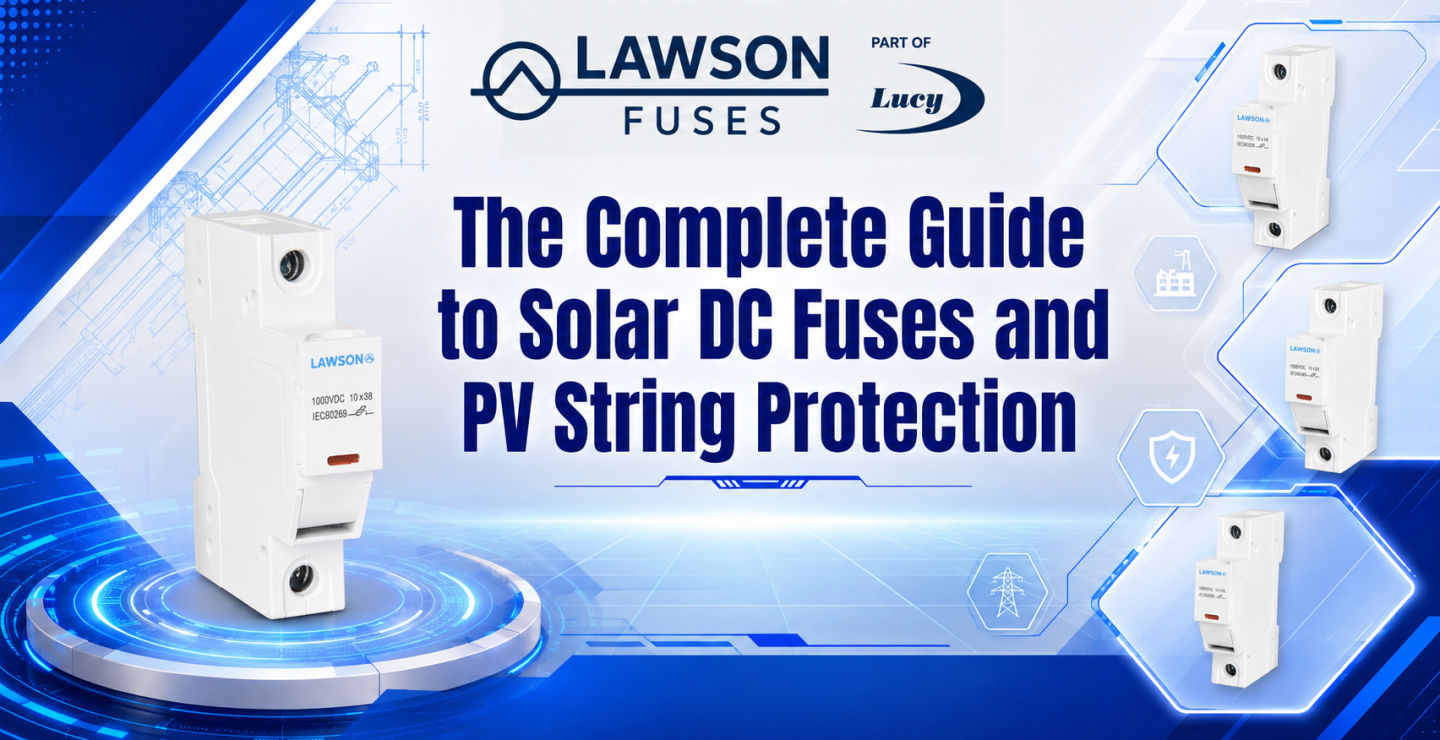
10×38 Fuse Holder — for 1000V DC Solar Fuse (1A–32A) The 10×38 PV fuse holder (Lawson MSC 101 / LPVG 10) is the most widely used format in solar combiner box applications. It accepts the standard 10x38mm solar DC fuse-link and provides a DIN rail-mountable, compact assembly for single-pole or multi-pole string fusing within a combiner box or junction box enclosure. Rated at 32A.
14×51 Fuse Holder — for Higher-Current String Protection (up to 50A) The 14×51 fuse holder (also referenced as 14×52) accepts larger 14mm diameter cylindrical fuse-links for higher-current PV string or sub-array fusing. Used in larger commercial or utility-scale combiner box applications where individual string currents exceed the 10x38mm format’s 32A maximum.
22×58 Fuse Holder — for DC Bus and Combiner Output Protection (up to 125A) The 22×58 fuse holder accepts the largest cylindrical fuse format and provides fusing at the combiner box output, DC bus, or inverter input level for higher-current aggregated PV array protection. Rated up to 125A.
Summary of PV Fuse Holder Selection
| Fuse Holder Format | Current Rating | Typical Application |
| 10x38mm | Up to 32A | Individual PV string protection (1000V DC) |
| 14x51mm | Up to 50A | Higher-current strings or sub-array fusing |
| 22x58mm | Up to 125A | DC bus, combiner output, inverter input |
All PV fuse holders should be:
- Rated for the full DC system voltage (1000V DC or 1500V DC as applicable)
- IP-rated for the installation environment
- Capable of DIN rail or panel mounting as required by the combiner box design
9. Where to Install Solar Panel Fuses in a PV System
Solar panel fuses are installed at the string level — one fuse per positive string conductor, located in the combiner box or string junction box between the PV string and the DC bus. Understanding exactly where in the system each fuse sits, and why, is essential for correct fuse specification.
Single-String Systems (No Fuses Required)
For a single-string inverter system — where one string of panels connects directly to one inverter MPPT input — no PV string fuse is required. With only one string connected to each inverter input, there is no parallel path through which reverse current can flow. The protection requirement in this case is met by the inverter’s own internal protection.
However, it is good practice to verify with the inverter manufacturer whether they recommend string fusing for single-string inputs on their specific product.
Multi-String Systems (Fuses Required)
For systems where two or more strings are connected in parallel to the same inverter MPPT input or DC bus — whether through a combiner box, junction box, or multi-MPPT inverter input — PV string fuses are required for each string.
This is the configuration where reverse current faults and multi-array faults can occur, and where the solar DC fuse provides critical protection.
Fusing location:
- One gPV fuse per positive string conductor
- Located in the combiner box or string junction box
- As close as practical to the string array output
Some system designs also include fusing on the negative string conductor, and fusing at the combiner box output — check the system design specification, inverter requirements, and applicable installation standards for the specific installation.
Where NOT to Use a Solar DC Fuse
A solar DC fuse should not be:
- Installed in AC circuits — solar DC fuses are rated for DC only and must not be used in AC applications
- Replaced with a standard DC fuse — as discussed throughout this guide, only a gPV rated fuse to IEC 60269-6 provides correct PV protection
- Oversized to prevent nuisance tripping — if a fuse is nuisance tripping, investigate the cause rather than fitting a higher-rated fuse. An oversized fuse will not protect the string cable and panels
10. Solar Fuse Specifications — What to Check Before You Buy
When sourcing solar panel fuses or PV fuses for any installation, verify the following on the product datasheet or packaging before purchase:
Essential Specification Checks
- Voltage Rating Must match or exceed the system maximum open-circuit voltage (Voc). For 1000V DC systems, specify a 1000V DC solar fuse. For 1500V DC systems, specify a 1500V DC solar fuse. Never use a 1000V rated fuse in a 1500V system.
- Current Rating Must be selected per the methodology in Section 6 above — not simply matched to the panel Isc.
- Utilisation Category Must be gPV (not gG, gM, aR, or any other category). Only gPV is tested for PV-specific fault conditions.
- Standard Compliance Must comply with IEC 60269-1 and IEC 60269-6. Check for CE marking as confirmation of compliance.
- Breaking Capacity Must be ≥ the maximum prospective fault current at the point of installation. For most PV string applications, a 20kA DC breaking capacity (as provided by the Lawson LFPV-32) is more than sufficient.
- Physical Format Must match the fuse holder installed in the combiner box — typically 10x38mm for 1000V DC string fusing, or 10x85mm for 1500V DC.
- Environmental Ratings For installation within enclosures: check working temperature range (the LFPV-32 covers -30°C to +70°C), relative humidity rating (≤95%), and altitude rating (≤2000m for the LFPV-32).
- Manufacturer Certification Ideally, specify a solar DC fuse from a manufacturer with ISO 9001 accredited manufacturing and ISO/IEC 17025 accredited test facilities — ensuring consistent, traceable performance in every unit produced.
Frequently Asked Questions
Q: How many strings do I need before PV string fuses are required?
As a general rule, string fuses are required when two or more strings are connected in parallel to the same inverter MPPT input or DC bus. With a single string per input, there is no reverse current path, so fuses are generally not required (verify with your inverter manufacturer). Always check the applicable installation standard and your system’s specific design requirements.
Q: Can I use a standard cylindrical fuse instead of a solar DC fuse?
No. Standard cylindrical fuses are neither rated for 1000V DC operation nor tested for the low overcurrent fault conditions (reverse current, multi-array faults) specific to PV systems. Only a certified gPV fuse to IEC 60269-6 provides compliant PV string protection.
Q: What happens if my solar DC fuse is undersized?
An undersized fuse will nuisance-trip under normal operating conditions — particularly during high irradiance periods when panel output Isc is at its peak. This results in loss of generation from the affected string. If nuisance tripping occurs, verify the current rating calculation using the methodology in Section 6 rather than simply fitting a higher-rated fuse.
Q: What happens if my solar DC fuse is oversized?
An oversized PV fuse will fail to operate under low-overcurrent fault conditions, leaving the string cable and panels unprotected during reverse current and multi-array faults. This can result in cable overheating, insulation damage, and fire risk. Always select the fuse rating based on the calculation methodology in Section 6.
Q: Do I need fuses on both the positive and negative string conductors?
Most PV system designs require fusing on the positive string conductor only, with the negative bus configured as a solid conductor. However, some design specifications and installation standards require both positive and negative fusing. Check your system design, the inverter manufacturer’s requirements, and the applicable national installation standard.
Q: Can I replace a blown solar DC fuse with a fuse of a higher current rating?
No. Always replace a blown solar DC fuse with one of identical type, voltage rating, and current rating. If the fuse has blown, investigate the cause before restoring the system — a blown fuse indicates a fault condition has occurred, and restoring the system without investigation risks further damage.
Q: What is the difference between a 10x38mm and a 10x85mm solar fuse?
Both are cylindrical photovoltaic fuses with 10mm diameter, but they differ in length — 38mm versus 85mm — and voltage rating. The 10x38mm fuse (e.g. Lawson LFPV-32) is rated at 1000V DC for standard PV systems. The 10x85mm fuse (e.g. Lawson LFPV-35) is rated at 1500V DC for high-voltage utility-scale solar. They are not interchangeable.
Q: Are Lawson LFPV solar fuses suitable for battery storage (BESS) applications?
Lawson LFPV solar DC fuses are primarily designed and certified for photovoltaic string protection. For battery energy storage system (BESS) applications, specific DC fuse requirements depend on the battery technology, voltage, and fault current characteristics. Contact the Lawson Fuses technical sales team for guidance on BESS fuse protection requirements.
Summary
Selecting the right solar DC fuse for your PV installation is not simply a matter of matching the current rating to the panel output. To summarise the key points from this guide:
- Only a certified gPV fuse to IEC 60269-6 provides compliant protection for PV string arrays — standard DC fuses are not suitable
- The two critical fault types — reverse current faults and multi-array faults — produce low overcurrents that only a gPV fuse is tested to detect and interrupt
- 1000V DC and 1500V DC solar fuses are not interchangeable — always verify the system Voc before selecting the fuse voltage rating
- The 10x38mm format (Lawson LFPV-32) is the industry standard for 1000V DC PV string fusing in ratings from 1A to 32A; the 10x85mm format (Lawson LFPV-35) is required for 1500V DC systems
- Current rating selection must follow the structured methodology — fuse In must be ≥ 1.25 × Isc and ≤ minimum of cable capacity and panel Irev max
- Always specify a PV fuse holder specifically rated for the DC system voltage
- String fuses are required for any configuration where two or more strings run in parallel to the same DC bus
About Lawson Fuses
Lawson Fuses is a UK-based manufacturer of high-quality fuse-links and fuse holders, part of the Lucy Group. Established in 1938, Lawson designs and manufactures certified fuse-links across every major international fuse standard — including the LFPV range of Solar DC Fuses for 1000V DC and 1500V DC photovoltaic applications.
All Lawson products are manufactured under an ISO 9001 accredited quality management system with test facilities independently accredited to ISO/IEC 17025, and certified to the relevant IEC and BS standards.